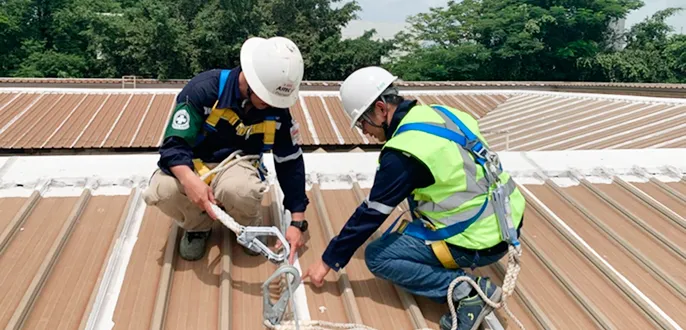
-
In-House Safety Training
Safety measures at construction sites in Thailand are often far from adequate. Many workers, supervisors, and contractors still lack awareness and experience in this area. The issue isn't that people disregard safety — it's that no one has ever taught them why it matters.
We conduct regular training on safety knowledge and skills for all our employees, thoroughly building safety awareness and ensuring standards are followed.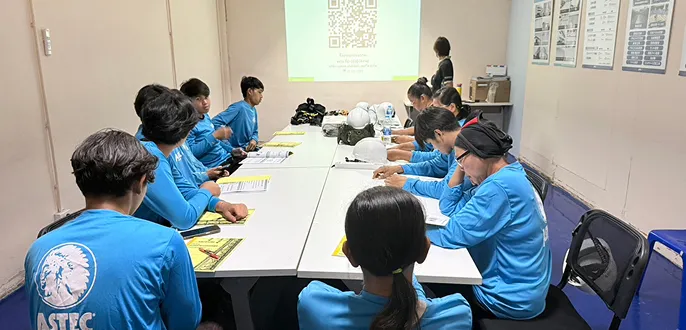
-
Installation of Safety Equipment
It's not uncommon for basic safety measures — like wearing a helmet or not entering in sandals — to go unenforced at job sites.
To eliminate this inconsistency, we always conduct KY (hazard prediction) activities before starting work. The whole team shares the scope of work and anticipated hazards, and we check attire, PPE, and sobriety before construction begins.
Rather than relying on individual awareness alone, we enforce daily, pre-task checks as a system — preventing accidents and injuries before they happen.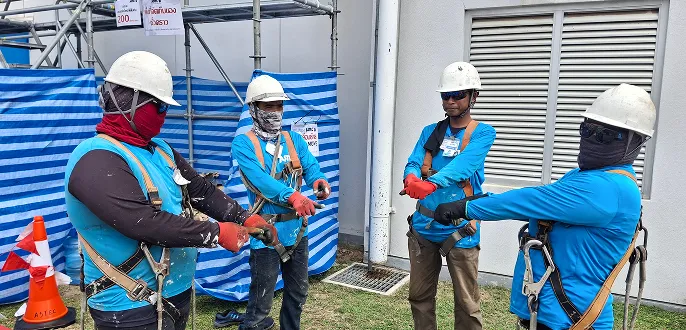
-
Scaffolding That Meets Safety Standards
For work at height, scaffolding quality has a major impact on safety.
We ensure not only safe ascent and descent, but also thorough measures for the surrounding area. Sound- and dust-blocking nets are installed around the perimeter to prevent falling debris and dust, with diagonal bracing for a stable, low-sway structure. We calculate load capacity in advance and post signage on the scaffolding to prevent overloading (e.g., 200kg depending on the site).
Traffic cones and Thai-language warning signs are placed around the area, with monitoring staff on hand to continuously watch for unauthorized entry.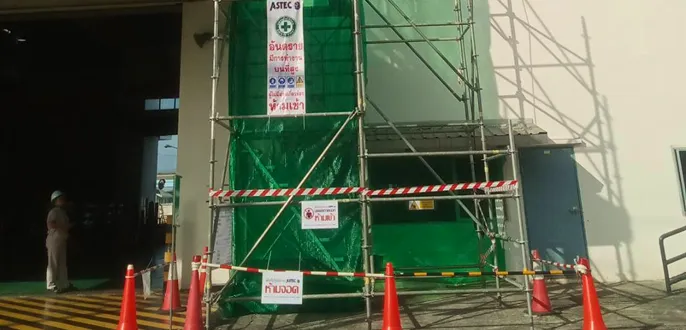
-
JSA (Job Safety Analysis) Submission
JSA (Job Safety Analysis) is a document that identifies hazards for each work process before construction and outlines prevention measures.
For projects involving high-risk processes such as roof demolition, work at height, or heavy machinery use, we prepare a JSA and submit it to the client before starting work.
It clearly identifies anticipated risks — such as falls, cuts, and contact with machinery — and specifies concrete procedures for PPE use, work zone setup, monitoring staff, and weather checks.
We share it with all on-site staff and reconfirm it in pre-work meetings, embedding safety awareness across the team.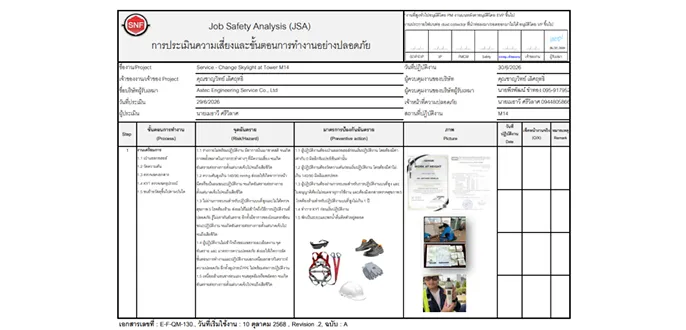
-
On-Site Supervisor Assignment
We assign one of our own employees as "Foreman" to supervise each job site. Their role is to continuously check that agreed work content and procedures are being carried out correctly, and that safety measures are followed as specified — keeping quality consistent.
They report daily progress to the client and serve as the point of contact if issues arise. Because it's our own staff on-site rather than a subcontractor, clients always know exactly who to contact, achieving both quality assurance and smooth communication.